
Eugenics and Criminology
As immigrants flood into America, the eugenics movement grows and the field of criminology emerges.
From
Eugenics and Criminology
Clip: Episode 2 | 3m 22sVideo has Closed Captions
As immigrants flood into America, the eugenics movement grows and the field of criminology emerges.
In the late-19th century and early 20th century, as millions of immigrants come into America, the pseudo-science of eugenics gains popularity, and the idea of a "criminal-type" takes hold.
From
Problems playing video? | Closed Captioning Feedback
Problems playing video? | Closed Captioning Feedback
Episodes presented in 4K UHD on supported devices. Major funding for CRIME AND PUNISHMENT IN AMERICA was provided by The Atlantic Philanthropies, Emerson Collective, The Andrew W. Mellon Foundation, and...
Eugenics and Criminology
Clip: Episode 2 | 3m 22sVideo has Closed Captions
In the late-19th century and early 20th century, as millions of immigrants come into America, the pseudo-science of eugenics gains popularity, and the idea of a "criminal-type" takes hold.
From
Problems playing video? | Closed Captioning Feedback
Where to Watch Crime and Punishment in America
Crime and Punishment in America is available to stream on pbs.org and the PBS app.

Measuring Crime and Punishment
How does the way we collect and measure crime shape our understanding of it? Crime statistics can tell us how crime changes over time. But the way crime is measured, defined, and communicated can also shape public perception and policy.Providing Support for PBS.org
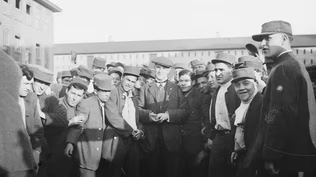
Learn Moreabout PBS online sponsorshipNarrator: The Italian anthropologist Cesare Lombroso established the field of criminology in the 1870s.
His theory of a criminal type based on inherited traits made sense to many white Protestant Americans, who were alarmed by the hundreds of thousands of immigrants arriving in the United States every year, most of them from Southern and Eastern Europe.
Kevin Boyle: People are coming with different religions; people are coming with different skin colors; people are coming with languages that weren't typically heard on the streets of America.
A lot of people look at that difference, and they see something dangerous in it.
Narrator: Many Americans embraced the new pseudoscience of eugenics.
With no evidence, eugenicists claimed that immigrants and poor people belonged to inferior races and carried defective traits.
Voice: Unless conditions change, the population of the United States will, on account of the great influx of blood from Southeastern Europe, rapidly become darker in pigmentation, smaller in stature, more mercurial, more given to crimes of larceny, kidnapping, assault, murder, rape and sex-immorality than were the original English settlers.
Charles Davenport.
Melissa Murray: The eugenics movement is enormously popular.
The idea here is that we can actually control for better traits.
It has the imprimatur of science, of logic.
It is taught at some of the best universities in the country.
And it sort of is premised on this idea that really bad character traits are actually heritable, so criminality is something that you inherit.
Voice: We believe it is established beyond controversy that criminals and paupers, both are degenerate; the imperfect, worm-eaten, half-rotten fruit of the race.
We do not propose to turn the criminal and pauper over to the executioner, as is done in some nations.
Progress of medical and surgical science has rendered it possible to remove or sterilize the organs of reproduction of both sexes without pain or danger.
Henry Boies.
Narrator: Dozens of states enacted laws authorizing forced sterilization of those they called "imbeciles, "drunkards, drug fiends, moral or sexual perverts, and habitual criminals."
In 1927, the Supreme Court would uphold the practice.
Voice: It is better for all the world if, instead of waiting to execute degenerate offspring for crime or to let them starve for their imbecility, society can prevent those who are manifestly unfit from continuing their kind.
Justice Oliver Wendell Holmes.
Narrator: By the end of the 20th century, as many as 70,000 men and women confined in America's prisons, asylums, and other institutions had been sterilized without their consent.

The Botched Execution of Roxalana Druse
Video has Closed Captions
Clip: Ep2 | 2m 34s | In 1887, a botched hanging compels Americans to turn from public hangings to the electric chair. (2m 34s)

Video has Closed Captions
Clip: Ep2 | 4m 45s | Lakota leader Crow Dog is murdered, and the federal government tries to change laws. (4m 45s)

Video has Closed Captions
Clip: Ep2 | 5m 37s | The American public grapples with the question of if criminals are born or made. (5m 37s)

Famous Trial Lawyer Clarence Darrow Defends the Sweet Family
Video has Closed Captions
Clip: Ep2 | 11m 10s | The legendary lawyer Clarence Darrow defends the Sweet family in their murder trial case. (11m 10s)

The Green Goods Game: The Most Devious Scam in America
Video has Closed Captions
Clip: Ep2 | 7m 42s | George Appo turns to a devious scam, the Green Goods game, to make money. (7m 42s)

The Lexow Commission Exposes Police Brutality and Corruption
Video has Closed Captions
Clip: Ep2 | 8m 40s | In 1894, the Lexow Commission forms to investigate corruption and police brutality among the NYPD. (8m 40s)

Video has Closed Captions
Clip: Ep2 | 11m 38s | George Appo turns to pickpocketing, and Inspector Thomas Byrnes uses the Third Degree (11m 38s)

The Police Clash with Bootleggers Over Prohibition
Video has Closed Captions
Clip: Ep2 | 5m 27s | Prohibition creates a black market for alcohol, leaving police struggling with enforcement. (5m 27s)

Suffragists and Kate Richards O'Hare on prison conditions
Video has Closed Captions
Clip: Ep2 | 6m 26s | Incarcerated suffragists access the press; Kate Richards O'Hare describe women she meets in prison. (6m 26s)

The Sweet Family faces Mob Violence in Detroit
Video has Closed Captions
Clip: Ep2 | 8m 53s | When the Sweet family moves into their new house in Detroit, they face mob violence. (8m 53s)

Thomas Mott Osborne Brings Reform to Sing Sing Prison
Video has Closed Captions
Clip: Ep2 | 10m 39s | Thomas Mott Osborne dedicates himself to reforming Sing Sing Prison (10m 39s)
Providing Support for PBS.org
Learn Moreabout PBS online sponsorship







Support for PBS provided by:
Episodes presented in 4K UHD on supported devices. Major funding for CRIME AND PUNISHMENT IN AMERICA was provided by The Atlantic Philanthropies, Emerson Collective, The Andrew W. Mellon Foundation, and...