
When Earth Was Bombarded by Asteroids
Clip: Season 53 Episode 1 | 3m 41sVideo has Closed Captions
What studying the surface of the Moon revealed about Earth’s apocalyptic youth.
Four and a half billion years ago, Earth was battered by relentless asteroid impacts powerful enough to vaporize oceans and melt its crust. Despite the chaos, life emerged anyway.
Problems playing video? | Closed Captioning Feedback
Problems playing video? | Closed Captioning Feedback
National Corporate funding for NOVA is provided by Carlisle Companies and Viking Cruises. Major funding for NOVA is provided by the NOVA Science Trust and PBS viewers.
Support provided by:


When Earth Was Bombarded by Asteroids
Clip: Season 53 Episode 1 | 3m 41sVideo has Closed Captions
Four and a half billion years ago, Earth was battered by relentless asteroid impacts powerful enough to vaporize oceans and melt its crust. Despite the chaos, life emerged anyway.
Problems playing video? | Closed Captioning Feedback
How to Watch NOVA
NOVA is available to stream on pbs.org and the free PBS App, available on iPhone, Apple TV, Android TV, Android smartphones, Amazon Fire TV, Amazon Fire Tablet, Roku, Samsung Smart TV, and Vizio.
Buy Now
NOVA Labs
NOVA Labs is a free digital platform that engages teens and lifelong learners in games and interactives that foster authentic scientific exploration. Participants take part in real-world investigations by visualizing, analyzing, and playing with the same data that scientists use.Providing Support for PBS.org
Learn Moreabout PBS online sponsorship- [Narrator] Craters are a reminder of our solar system's formation around 4.56 billion years ago.
It began as a disc of dust and gas in orbit around the young sun.
The solid materials collided and clumped together to gradually form the rocky planets.
- As a result of the formation of the earth, there were still lots of debris and asteroids and other smaller objects flying around the sun.
Those objects kept colliding with the surface of the earth.
- [Narrator] About four and a half billion years ago, a single object the size of Mars or even bigger may have crashed into the young Earth.
This high resolution simulation reveals how the collision flung enough molten and vaporized debris into space to create the moon.
- I'm trying to understand the early evolution of the earth and the effects of all those impacts that were taking place during the Hadean earth.
So we do this by building models.
- [Narrator] One of the most important sources of data comes from NASA's Lunar Reconnaissance Mission.
This robotic spacecraft has made a 3D map of the moon's surface at extremely high resolution.
- The first thing that we do is to look at the surface of the moon.
It is much older than the surface of the earth.
The surface of the moon is full of impact craters old impact craters, and so we can use that information by mapping how many there are and their sizes and their ages, and that will provide us the primary information that we need to build our model.
- [Narrator] It took an international team decades to collect the data, but they finally created a computer model that took what happened on the moon during the Hadean and simulated the asteroids that would've hit the earth during the same stretch of time.
- And the outcome of that first modeling was staggering.
We are seeing the entire surface of the earth that is strongly affected by impact.
So every single circle that you see here is an impact, is a collision.
The prediction was that there were a tremendous number of impacts, even large one.
Imagine an object the size of the moon that could have collided with the earth.
That would've basically wiped out almost entirely perhaps the oceans, vaporized the oceans and melted a large portion of the crust of the earth.
- [Narrator] This series of apocalyptic bombardments might look like it created a chaotic hellscape on earth.
Even during asteroid impacts, there must have been enough habitable conditions somewhere on the planet for life to get a foothold.
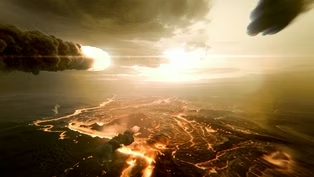
Asteroids: Spark of Life? Preview
Video has Closed Captions
Preview: S53 Ep1 | 30s | What if violent asteroid impacts actually jump-started life on Earth? Explore a dramatic theory. (30s)
Providing Support for PBS.org
Learn Moreabout PBS online sponsorship
- Science and Nature

Capturing the splendor of the natural world, from the African plains to the Antarctic ice.













Support for PBS provided by:
National Corporate funding for NOVA is provided by Carlisle Companies and Viking Cruises. Major funding for NOVA is provided by the NOVA Science Trust and PBS viewers.