
WETA Arts May 2023
Season 10 Episode 8 | 28m 49sVideo has Closed Captions
Washington Women in Jazz; Tap Dance; Doug Yeuell, Atlas Performing Arts Center
In May’s episode of WETA Arts, meet pianist, vocalist, and composer Amy K. Bormet, the founder of the Washington Women in Jazz Festival. Plus, explore the deep history of tap dance with the leaders of the Capitol Tap and District Tap dance companies. And, host Felicia Curry speaks with Douglas Yeuell, the executive director of the Atlas Performing Arts Center in Northeast DC.
Problems playing video? | Closed Captioning Feedback
Problems playing video? | Closed Captioning Feedback
WETA Arts is a local public television program presented by WETA
WETA Arts May 2023
Season 10 Episode 8 | 28m 49sVideo has Closed Captions
In May’s episode of WETA Arts, meet pianist, vocalist, and composer Amy K. Bormet, the founder of the Washington Women in Jazz Festival. Plus, explore the deep history of tap dance with the leaders of the Capitol Tap and District Tap dance companies. And, host Felicia Curry speaks with Douglas Yeuell, the executive director of the Atlas Performing Arts Center in Northeast DC.
Problems playing video? | Closed Captioning Feedback
How to Watch WETA Arts
WETA Arts is available to stream on pbs.org and the free PBS App, available on iPhone, Apple TV, Android TV, Android smartphones, Amazon Fire TV, Amazon Fire Tablet, Roku, Samsung Smart TV, and Vizio.
Providing Support for PBS.org
Learn Moreabout PBS online sponsorship♪ Hey, everybody.
I'm Felicia Curry, and welcome to "WETA Arts," the place to discover what's going on in the creative and performing arts in and around D.C.
In this episode, women play jazz...
I have people coming back and performing with me at Blues Alley that were on my showcase 10 years ago.
Curry, voice-over: tap dancers preserve dance history... Woman, voice-over: What we teach is to pass it on so those pieces live forever.
Curry, voice-over: and I talk with Douglas Yeuell, the executive director of the Atlas Performing Arts Center, a cultural anchor on H Street Northeast... We're always about compelling work that addresses the multifaceted, diverse populations not only in Northeast D.C., but the District at large.
all these stories coming up on "WETA Arts."
♪ Jazz is a profound part of the history of Washington, D.C., with clubs that welcomed the greats and nurtured D.C.'s own jazz talent.
D.C.'s premier arts public school, the Duke Ellington School of the Arts, is named after one of D.C.'s native sons.
♪ Let's make a change... ♪ Curry, voice-over: When pianist Amy Bormet began at Ellington, she didn't imagine she would become not only a musician, but also an advocate for women.
♪ Oh ♪ Man: Amy, how you feeling, good?
Good.
The vocals sound really trebly up here.
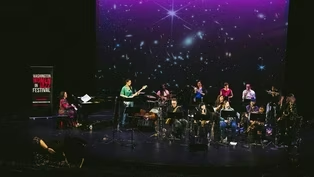
♪ Curry, voice-over: It's the first and only rehearsal before the first performance of a new big band called the Celestial Spang-A-Lang.
Spang-a-Lang is a beat pattern for jazz drums, and "celestial" refers to the all-star performers at tonight's gig.
♪ Bormet, voice-over: They're gonna be solid, and everyone coming in are, like, very phenomenal improvisors and also really great session readers.
♪ We pick people who function well under pressure.
♪ Curry, voice-over: Celestial Spang-A-Lang's performance is part of the month-long Washington Women in Jazz Festival, founded by Bormet.
Bormet: I started Washington Women in Jazz in 2011, and I had just done a residency at the Kennedy Center... ♪ Rising heat ♪ ♪ Bormet, voice-over: and I wanted to be on bigger jazz festivals.
I started looking at them... ♪ and there'd be no women instrumentalists anywhere on the schedule, even within the bands.
♪ I knew all of these women who were performers here, and I said, "Well, what if I create something "that we can collaborate on to gain an audience for women musicians?"
This is my big hit, had it played on the radio.
♪ Let's make a change ♪ ♪ For the better ♪ ♪ No more excuses ♪ ♪ And no more lies ♪ ♪ Let's make a change... ♪ Curry, voice-over: As a child in Oregon, Bormet learned to play on her grandmother's piano.
Jazz and I have had a beautiful, beautiful relationship.
I grew up listening to Duke Ellington, Count Basie, Ella Fitzgerald, Sarah Vaughan, and what I really wanted when I first started playing was a connection.
I played a lot of classical music, and jazz was really a space that I could be myself 100% and create with people in a way that it was different every time it happened.
My father moved here, and I was living in Oregon.
He said, "Oh, I scheduled something for you, "this audition.
There's a school here called Duke Ellington," and I was already a huge Duke Ellington fan, and I was like, "Wait.
What?"
so I went to the school the Friday before Labor Day and auditioned and got in, and I remember calling my mom being like, "Mom, I'm not coming home.
I'm gonna start school on Tuesday."
It was definitely a male-dominated space, so that's not really something that bothered me because I was already, you know, a white person in a mostly Black space, so I was already othered.
♪ What really was important to me is that I had the chance to meet other professional women jazz musicians-- Shirley Horn and Geri Allen and Abbey Lincoln and, like, all of these people who I went to see perform and then got to meet.
The opportunities that had been given to me, a lot of them have come through the women that knew how intensely dedicated and passionate I was about this music.
So it's snare.
It's the same thing happens on the bridge.
♪ Curry, voice-over: Bormet met drummer Angel Bethea while teaching at Duke Ellington's Summer Jazz Arts Institute.
I first met Amy, so 13, 14 years old.
She was telling us drummers how important it is to know every part of the music, not just the rhythm, not just playing drums, so she had us scatting, which was-- You know, I can't sing, so I was like, "Amy, what's going on here?"
but that was really important to my development and being able to connect with the other musicians on stage.
When I saw her play, I was like, "Oh, that's interesting.
OK. OK.
I see what you're doing there."
Bethea: I started playing a lot more gigs through Women in Jazz.
Bormet: She came and performed at the Emerging Artists Showcase, where I can have college and high-school women and nonbinary jazz musicians come and perform and meet each other and network.
Bethea: She made sure to connect me with other people who looked like me to make sure I was that it was possible to become a musician and do this for a living.
Curry, voice-over: This year's Emerging Artists Showcase is at Mr. Henry's on Capitol Hill and includes students from Boston and New York as well as more local musicians.
♪ Woman, voice-over: I chose the saxophone in fourth grade.
I watched "The Princess and the Frog," and it's set in New Orleans, so there's a jazz band.
♪ I just really liked the way that it sounded, and, luckily, like, no one else wanted to play it, so there were enough school instruments for me to borrow one.
There weren't that many other girls playing saxophone.
Woman, voice-over: All my private teachers were men and specifically white men, actually.
When I got to school, my saxophone teacher, Ms. Alme, she's a woman, and that, like, changed my whole perspective, just feels good to have somebody to look up to that's more like me.
♪ Bah, voice-over: A showcase like this, it allows us female-identifying jazz musicians to support each other through our playing.
Oh.
It was dope.
We got to play together for real.
Like, we actually have to play together, for sure.
Now that I've, like, been here and, like, have, like, the Mr. Henry's vibe, I might make an appearance at the jam sessions on Wednesdays since I, like, know about them now, so maybe.
For sure.
Bormet, voice-over: The Emerging Artists Showcase is my favorite thing on the whole festival.
I continue to do it, even though it's crazy amount of work, because it's so exciting and energizing to be in the room with these people and to also see the way that they develop their careers after this.
[Cheering and applause] I have people performing with me at Blues Alley that were on my showcase, you know, 10 years ago.
Curry, voice-over: Blues Alley is one of Washington's premier jazz venues and another stop on the Washington Women in Jazz Tour.
Bormet, voice-over: Blues Alley is a super exciting place to highlight all of the amazing women that I play with, and it's a wonderful spot to perform because you can hear each other so well, but it's also a legacy place.
I would go down there after school and hang out for the sound check and hear, like, McCoy Tyner and Ahmad Jamal and, like, Mose Allison.
To have Washington Women in Jazz there, it's an achievement for the festival.
[Cheering and applause] Thank you, thank you.
I've lived different places and traveled all over, and I keep coming back to D.C. because of the sense of community and also the sense of political power through the arts.
I want to inspire people because this is a festival that's very much DIY.
It's very low-budget.
I want people to feel like if you rely on your community, if you rely on these collaborations, if you ask people for help, you can make something bigger than just yourself and to think about what changes they want to see within not only their workplace and their career, but also the wider community of D.C. [Applause] Curry: Amy Bormet will be playing and The Parks at Walter Reed in Northwest on Thursday, August 12.
Check the website for details and for more upcoming performances.
Hollywood introduced the world to tap through dancers like Fred Astaire, Gene Kelly, and Shirley Temple.
♪ You'll be their favorite child... ♪ Curry, voice-over: However, at Knock On Wood Tap Studio in Tacoma Park, D.C. ...
Morning, Miss Lisa.
Curry, voice-over: Students are following less well-known stars.
♪ Good morning ♪ ♪ 1... ♪ [Tapping and stomping] Go.
Curry, voice-over: It's the last rehearsal before a world premiere.
Lisa: ♪ 1, 2 ♪ This cannot happen on stage.
Curry, voice-over: This new piece called "Open Secret" is debuting in an evening-length performance featuring the group Capitol Tap as well as it's sister company District Tap.
♪ Oh, Lord... ♪ Curry, voice-over: Both companies call Knock On Wood Tap Studio home.
While District Tap is for advanced adult dancers, Capitol Tap is for young tappers.
Lisa: Lovely, lovely.
That was a lot better.
I'm so proud of your 3.
It's vastly different than Wednesday.
Curry, voice-over: Director Lisa Swenton-Eppard founded Capitol Tap in 2010.
Capitol Tap and District Tap are a place where we honor history.
We learn about ourselves.
We gain leadership skills.
We become better citizens, and we also tap-dance a little.
When I was two, 2 1/2, the kitchen, that's where I had my little tap studio.
One of our family friends made these little Tic Tac boxes with these fancy rubber bands so I could put them on my shoes, and those were my first pair of tap shoes.
[Tapping] Woman, voice-over: I started when I was 7 just learning a couple shuffles, and then you start learning your trick steps and your rhythms, and it gets progressively more intense.
Swenton-Eppard: ♪ 1... ♪ Holland, voice-over: I wanted something that would really push me, and that's why I found Capitol Tap.
As a senior, I do teach a lot of the younger members... You do this.
It's like that but with one arm.
Holland, voice-over: dances that are part of our history, dances that are part of tap dance history in general.
Manor, voice-over: I'm excited to be back on stage, just a lot of, like, jittery butterflies in my stomach.
Oh, no.
Go all the way back to before you open up.
Curry, voice-over: Swenton-Eppard also started learning and teaching tap at a young age.
Uh, enter as a straight line.
Yeah.
Swenton-Eppard: My mother was my tap teacher.
She set up a playpen in the corner of the studio for me.
I was teaching all throughout high school.
I was part of the college dance team.
Then when I graduated, I had my full-time job during the day, and I was teaching at night.
Dancing in my mom's studio, we were learning Broadway-style tap dance.
♪ Then I walked into Miss Yvonne's class.
Miss Yvonne's class was life changing for me.
♪ Dee dee dee boom bom ♪ All right.
Ha ha ha!
Curry: Yvonne Ellen Edwards-- Miss Yvonne, as she prefers to be called-- is the co-founder of Knock On Wood Tap Studio.
Miss Lisa, she was in the class, and she had good feet, always had good feet.
What I grew up with was more of the visual in front with the music secondary.
The style of tap that she taught had a melody behind it.
Edwards, voice-over: We do the jazz type tap dancing.
Kids used to say, "I take tap because I like to make noise."
It's not noise.
It's music.
[Stomping and tapping] Curry, voice-over: Capitol Tap's assistant director, Baakari Wilder, was also a student of Miss Yvonne's.
Miss Yvonne, that's one of my first teachers.
I started when I was 3.
Edwards: I told him, "He's gonna send me back to tap school," he was learning things so fast.
Wilder: Her tap company Tappers With Attitude brought in artists from out of town.
Gregory Hines came down.
Savion Glover would teach residencies, and that only allowed me to grow even more.
Curry: Wilder went on to star in the Broadway hit "Bring in 'da Noise, Bring in 'da Funk," created by Savion Glover and George C. Wolfe.
Wilder: To grow with my peers inside of a production like that, it made me the teacher I am and the dancer I am.
Edwards: When they had "Bring in 'da Noise, and Bring in 'da Funk," everybody wanted a class.
I couldn't teach enough.
I started coming to her class every week.
In 2002, I was asked to come on as a director for Tappers With Attitude.
I ended up in Baakari's Monday night tap class, and then when I was 10, I was invited to audition for Tappers With Attitude.
After Tappers With Attitude had closed, all of these tap dancers still wanted a place to tap-dance.
Swenton-Eppard: When you exit, make sure you exit.
Exit.
Swenton-Eppard, voice-over: I walked into the Baltimore Small Business office and paid $200, and, voila, here I am.
I'm now a business owner.
Ha ha ha!
Wilder: Lisa asked me to join her.
Swenton-Eppard: I said, "What do you want your legacy here to be?"
Good.
♪ A-1, 2, ready, and... ♪ Wilder, voice-over: A lot of valuable information about the artform was handed to me.
♪ A-1, 2, ready, and... ♪ Wilder, voice-over: I feel a responsibility to not only encourage its growth, but also to remind others of its roots.
This is an American artform with African roots.
When we were brought over here as slaves, one of our strongest forms of communication was the drum.
♪ Swenton-Eppard: In the Stono Rebellion, enslaved people fought back.
The enslavers made it even harsher conditions, and one of those was taking away their drums.
Wilder: What existed inside that drum was our pulse, our rhythm, our beat.
Swenton-Eppard, voice-over: Those rhythms that they had in their drums just moved to their body.
We have to make sure that it is absolutely understood that this artform, as much as it is full of joy, it is build upon a base that is horrific.
Woman: ♪ 'Tis the old ♪ ♪ Ship of Zion ♪ Curry, voice-over: Capitol Tap's new performance "Open Secret" is about Harriet Tubman's letter to her family that said in code that she was coming to rescue them.
Swenton-Eppard, voice-over: This piece is the story of the letter's journey.
This was a journey for us.
With the cast, we talked through all of these sets of discomfort.
You cannot talk about tap dance without talking about race.
Manor, voice-over: I was against the piece.
I've had, like, a emotional come to see the light with this piece.
I really bonded with Miss Lisa over it.
Yeah.
There.
It's not-- No.
Uh-uh.
Yeah.
Wilder, voice-over: We've instilled the history of this artform.
Swenton-Eppard, voice-over: Which why we go back to studying the works of the tap masters who have since passed.
Woman: ♪ There a ship... ♪ Curry, voice-over: Miss Yvonne in particular has a special connection to the history of tap.
Born in 1934, Miss Yvonne learned from tappers just two generations removed from being born enslaved.
I was taking ballet at a studio on Georgia Avenue, and the lady there was very proficient at tap dance, and I took classes with her, and then my brother married a dance teacher in Atlantic City, New Jersey, which she was very proficient in tap.
She had a little storefront building, and that's where we taught.
♪ There was a club in Atlantic City called the Club Harlem, and a lot of the old guys, they used to come there and perform-- Jimmy Slyde, Buster Brown, the group called the Copacetics-- and during the day, they would come over to the studio with us, so I was sitting in the corner and watched.
Every now and then, they would tell me, "Get up, girl.
Come and learn this routine," or, "this step."
That's what I liked to do.
Bill "Bojangles" Robinson, he was history to me.
♪ Woman: Hee hee hee!
All right.
Enter.
Curry, voice-over: In addition to brand-new pieces like "Open Secret," Capitol Tap and District Tap's program includes pieces that are a hundred years old.
Swenton-Eppard, voice-over: "Hoofers Line" is one of the pieces that Baakari makes sure gets passed on with integrity.
There's a line in the back called the track doing what's called a paddle and roll over and over for infinity.
The paddle and roll, I can explain the step for you with my hands.
Holland: You dig your heel into the ground you spank your toe back, you dig your toe down, and then you hit your heel.
♪ Oh, yeah... ♪ Swenton-Eppard, voice-over: Somebody will pop out of that line and just share improvisation.
Then they move back, and the next person pops out.
♪ Oh, yeah... ♪ Wilder, voice-over: I teach it back on the heels-- ♪ Hobba-dooba dobba-dooba dobba-diz ♪ ♪ Dada da dada da dada da dada da da ♪ ♪ Oh, yeah, oh, yeah... ♪ Baakari's my family.
[Tapping] Yeah.
Yeah.
Holland, voice-over: He'll tell you if what you did is wrong, and he'll let you know, but he wants you to be better.
Ha!
The last time I came, they were so into trying to get it right that I got tired of looking at them, you know?
That's supposed to be entertainment.
Swenton-Eppard, voice-over: Miss Yvonne called and said, "Tell your dancers that I want to see smiles.
I want to see teeth and gums"-- ha ha ha!-- so she's expecting a very exuberant performance, and we'll give it.
[Car horn honks] Curry, voice-over: At Atlas Performing Arts Center, Capitol Tap and District Tap perform to a sold-out house.
Please join me in giving them a warm round of applause.
[Applause] ♪ I got on board ♪ ♪ Early one morning ♪ ♪ Let's go ♪ ♪ Oh ♪ ♪ That's right ♪ ♪ Oh ♪ ♪ That's true, that's free ♪ ♪ Oh ♪ [Cheering and applause] The song about Harriet Tubman was really incredible.
Edwards, voice-over: The one with the letter, that was very touching, very, very touching.
Miss Yvonne, she's my heart.
I can't let all the work that she put into the studio and all the people that she touched in this D.C. area just end.
The future of tap is always in danger.
What we teach is to really honor the works and know it really, really well so then you can pass it on to the next generation that's coming up behind you so those pieces live forever.
[Cheering and applause] You can see Capitol Tap and District Tap performing on Saturday, May 13, at Button Farm Living History Center in Germantown, Maryland, as part of an event honoring Harriet Tubman.
You can also see them perform on Sunday, June, 11, at Montgomery Blair High School in Silver Spring, Maryland.
Are you a tapper?
Capitol Tap and District Tap are holding auditions throughout the month of May.
Check their website for details.
The Atlas Theater in Northeast Washington was at one time one of only 4 movie theaters in D.C.
It fell into disrepair after the 1968 riots that ravaged the neighborhood.
Douglas Yeuell was one of the arts leaders involved in transforming it into the performing arts hub that it is today.
I met with Yeuell, now the executive director of the arts center, to talk about his plans for this cultural jewel on H Street.
Hi, Douglas.
Welcome to "WETA Arts."
We are so happy to have you with us.
Well, thank you.
Thank you for having me.
It's an absolute pleasure.
We are so excited to be here at the Atlas Performing Arts Center, so what, exactly, do you do here?
We do theater.
We do dance.
We do music.
We have spoken-word artists.
We have poets.
We do it all.
And tell us a little bit about the history of the Atlas.
The Atlas was built in 1938 as a movie theater that served the community.
after the assassination of Dr. Martin Luther King, H Street was an epicenter of the riots.
The story goes, once the smoke rose, the Atlas still stood, and so for many of us, we believe that that is a testament to the role that the Atlas played in many people's lives.
The theater sat abandoned for a while.
Then what happened?
This building sat empty well over 33 years.
Jane Lang and her other supporters created to idea of the Atlas Performing Arts Center.
They built the Atlas in stages.
The Atlas was a big mud pit at the time.
The dance studios were completed first and thus the beginning of the Atlas.
Tell me a little bit about your dance background.
What brought you to your journey of dance?
I have an older sister who danced, and I was the little brother that was always following in her footsteps.
It wasn't until I went to college where my sister finally says, "You need to take a dance class," so I started dancing in college, which is very late for a dancer.
I graduated, moved here to D.C., and did retail management by day, and I danced by night.
I danced at Joy of Motion Dance Center, became a teacher.
Over the years, that progressed into teaching engagements throughout the U.S.-- colleges, universities-- taught internationally and ran a dance studio on top of it.
Now you're the executive director here at the Atlas Performing Arts Center.
Tell me how that was for you.
It was a great surprise, but I ultimately thought to myself, "The universe knocks when the universe knocks, and maybe you need to listen."
Having the quilt in the building is enough of a reason for people to come to Atlas.
Yeuell, voice-over: We have a great team of employees that work here day in and day out that are also dedicated to making a difference for all of those that come here, whether it be community, patrons, or artists.
I hope what we're creating is a special environment that you can't get anywhere else.
Curry: Tell us a little bit about what we can expect to see in May and in the summer here at the Atlas Performing Arts Center.
There's a lot going on, which is a good thing.
[Whoosh] Yeuell, voice-over: The theatrical productions that we have are Mosaic Theater Company of D.C. as a resident arts partner here at the Atlas-- they'll be presenting work here-- Solas Nua Theater Company, which is an Irish-based theater company.
We also have our production of "The Welders" that will be here in June.
Those are the theatrical productions.
Our resident arts partner Capital City Symphony will be presenting with their spring concert.
♪ Our City at Peace youth development program, teens come here, learn a curriculum of social justice, and that is turned into an original theatrical production that we present in June, and every year, I am awed at what these young adults create.
What do you say to the folks who say, "I go to Northwest to see shows.
That's where I go"?
How do you convinced them to come here to Northeast to the Atlas Performing Arts Center?
I would like to debunk the myth that the only people that enjoy and participate in the arts are people from Northwest D.C. We're in Ward 6.
We're right next to Ward 5.
We're Capitol Hill.
We're Trinidad.
People live here.
This is a whole area that exists.
There are people that have a performing arts center in their backyard.
Who gets that, right?
We are a destination for art.
People are here from Virginia, from Maryland.
Programatically, we're always about what are we doing to create compelling work that addresses the multifaceted, diverse populations that we serve here not only in Northeast D.C., but the District at large, and we're just so happy to be able to host that.
Douglas, thank you so much for having us here at the Atlas today and for talking with us.
Thank you so much.
It's been an absolute pleasure.
Atlas Performing Arts Center will host artists in its residency program at an evening-length event including Duke Ellington graduate writer-singer Christopher Prince and Maryland-based dancer Madeline Maxine Gorman.
More details are at atlasarts.org.
Here's a reflection from the nation's first president-- George Washington.
"To encourage literature and the arts is a duty which every good citizen owes to his country."
Thank you for watching this episode of "WETA Arts."
Be well, be creative, and enjoy the art all around you.
I'm Felicia Curry.
Announcer: For more about the artists and institutions featured in this episode, go to weta.org/arts.
♪ ♪ ♪ ♪ ♪ ♪
Preview: S10 Ep8 | 30s | Washington Women in Jazz; Tap Dance; Doug Yeuell, Atlas Performing Arts Center (30s)
Providing Support for PBS.org
Learn Moreabout PBS online sponsorship

- Arts and Music
The Best of the Joy of Painting with Bob Ross
A pop icon, Bob Ross offers soothing words of wisdom as he paints captivating landscapes.











Support for PBS provided by:
WETA Arts is a local public television program presented by WETA