
Galaxies: Home Sweet Home
Special | 7m 28sVideo has Closed Captions
Where in the galaxy do we live? Find out.
Galaxies are the fundamental building blocks of the universe. By studying them, we can learn how the universe began and how it's changing. That's important because a galaxy is where we live. Learn more about galaxies.
Problems playing video? | Closed Captioning Feedback
Problems playing video? | Closed Captioning Feedback
Science Trek is a local public television program presented by IdahoPTV
Major Funding by the Laura Moore Cunningham Foundation and the Idaho National Laboratory. Additional Funding by the Friends of Idaho Public Television and the Corporation for Public Broadcasting.
Galaxies: Home Sweet Home
Special | 7m 28sVideo has Closed Captions
Galaxies are the fundamental building blocks of the universe. By studying them, we can learn how the universe began and how it's changing. That's important because a galaxy is where we live. Learn more about galaxies.
Problems playing video? | Closed Captioning Feedback
Where to Watch Science Trek
Science Trek is available to stream on pbs.org and the PBS app.
Science Trek
Science Trek is a place where parents, kids, and educators can watch short, educational videos on a variety of science topics. Every Monday Science Trek releases a new video that introduces children to math, science, technology, engineering, and math (STEM) career potentials in a fun, informative way.More from This Collection
Ever since human first looked up in the night sky and wondered what was out there, we have been trying learn more about outer space. Explore the planets. Study asteroids and comets and find out what it is like to train to be an astronaut.
Video has Closed Captions
Asteroids and comets can teach us about the beginnings of the universe. (6m 20s)

Exoplanets: Finding Life With the JWST
Video has Closed Captions
Will biosignatures help us find life on exoplanets? (5m 26s)
Video has Closed Captions
Learn what astronomers learned through the ages. (5m 52s)
Video has Closed Captions
The James Webb Space Telescope could bring amazing discoveries. (6m 53s)
Satellites: The Story of Satellites
Video has Closed Captions
What is a satellite and how do human-made satellites study the Earth and the Universe. (5m 32s)
Satellites: Using Satellites to Find Treasure
Video has Closed Captions
GPS satellites help us navigate around the world and can help us find treasure. Learn how. (6m 22s)
Planets: What Exactly is a Planet?
Video has Closed Captions
How do you decide what a planet actually is? (5m 29s)
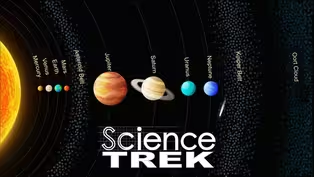
Planets: Tour the Solar Neighborhood
Video has Closed Captions
Take a tour of our Solar System and learn about planets and much more. (6m 3s)
Video has Closed Captions
Learn more about the Earth's only natural satellite. (5m 15s)
The Moon: Can You Visit the Moon in Idaho?
Video has Closed Captions
Why did the Apollo astronauts train in Idaho? (6m 7s)
Providing Support for PBS.org
Learn Moreabout PBS online sponsorshipJoan Cartan-Hansen,Host: Galaxies are the fundamental building blocks of the universe.
And by studying them, we can learn how the universe began and how it's changing.
And that's important because galaxies are where we live.
[MUSIC] STUDENT ONE: What are we doing today?
STUDENT TWO: We are going to be traveling through the galaxy.
STUDENT ONE: What?
STUDENT TWO: Using special effects, we'll going to be traveling through the galaxy.
[electronic shimmer] Let’s go!
STUDENT ONE: A galaxy?
What's that?
Joan?
CARTAN-HANSEN: A galaxy is a giant group of stars hundreds of thousands of light- years across.
It contains hundreds of billions of stars all held together by gravity.
STUDENT ONE: How do galaxies form?
CARTAN-HANSEN: Let's ask an expert.
DR.
BARNES: Well, that is a great question that we actually don't fully know the answer to now.
Of course, our own galaxy formed some 13 billion years ago, so it's hard to go back and look at what happened to be able to create our galaxy in the first place.
However, in astronomy, we can cheat.
STUDENTS TOGETHER: Cheat?
BARNES: If you look 13 billion light-years away, you're actually looking 13 billion years ago in time.
So, we can't see how our galaxy formed, but we can look 13 billion light-years away and see how other galaxies formed at the other edge of the universe back when the universe was young.
And it seems like galaxies initially form as small clumps of stars that eventually crash together, growing ever larger over time as they eat each other and grow larger and larger.
And that's how we think our own galaxy formed as well.
STUDENT ONE: What's the difference between the planets, the solar system, the galaxy and the universe?
BARNES: So we now know that we here on earth just exist on a very tiny fraction of the whole universe in which we live.
Our Earth is orbiting the Sun, and the set of all the planets orbiting the Sun are called our solar system.
CARTAN-HANSEN: ... and all the solar systems make up a galaxy and all the galaxies make up a universe.
So, one.
Two.
Three.
Four.
There are three basic types of galaxies in the universe.
Elliptical galaxies are giant, egg shaped grouping of stars.
Irregular galaxies have bunches of new stars forming inside and have gases within them.
They really don't have a specific shape.
And there are spiral galaxies.
They are sort of a mixture of the two.
Our galaxy, the Milky Way, is a barred spiral galaxy.
It has a large egg-shaped structure in the center, made up of older stars.
And there's a flat pancake known as a disc, of younger stars and gases that are actively forming new stars.
STUDENT TWO: So where is our solar system inside the Milky Way?
BARNES: So the sun and our solar system is located about two thirds of the way from the center, the egg shaped part of the core of the galaxy, the bulge out to the edge.
So we're sort of in the outskirts, sort of like in the suburbs of the Milky Way.
CARTAN-HANSEN: At the center of the Milky Way is a black hole.
A black hole is a region of space where a star or other mass has collapsed in on itself.
It's called a black hole because gravity stops everything, including light, from escaping.
The black hole at the center of the Milky Way is called Sagittarius A-star.
It's about the size of our solar system but packed with a mass two million times larger than our sun.
BARNES: Most galaxies have black holes.
Those elliptical galaxies and spiral galaxies, the ones that have a lot of structure, those all seem to have a super massive black hole at the center holding them together.
The irregular galaxies, however, don't seem to all have black holes or not many of them have black holes anyway, as they're like little baby galaxies that are just getting started.
And frequently, I'm sorry to say galaxies are cannibals.
STUDENTS TOGETHER: Cannibals!
BARNES: Those little irregular galaxies are going to get eaten up by bigger galaxies and contribute their stars to the bigger hole over time.
In fact, our Milky Way has two moon galaxies orbiting around it called the large Magellanic Cloud and the small Magellanic cloud that are these irregular galaxies that are in the process of being eaten by the Milky Way to become part of the Milky Way over time.
CARTAN-HANSEN: Our galaxy contains about 300 billion stars.
And there are a couple hundred billion galaxies in the universe.
So, scientists estimate there are 1 with 22 zeros number of stars.
That's more stars than there are grains of sand on the entire earth.
STUDENT ONE: What else besides stars are in the universe?
BARNES: We just learned about 20 or 30 years ago that most of our universe is not made of stars and stuff like we know it, protons, neutrons, and electrons.
In fact, our galaxy is composed, we think of about five to six times more dark matter than stars.
And dark matter is stuff that doesn't seem to interact with light.
And so, we can only sense its presence by its gravity.
And we've discovered that the way that galaxies rotate and the way that they interact within each other, as well as the way they form and the way the universe formed, is consistent with there being this tremendous amount of dark matter passing through our bodies every second, but not interacting with any of the atoms in our bodies.
STUDENT TWO: Wow.
Earlier, you said something about a light year.
What's that?
CARTAN-HANSEN: A light year is how scientists measure the vast distances in space.
It's the distance light travels in one year.
So, that means one light year is about five point eight trillion miles.
Because light-years are so big, scientists needed something to measure smaller distances.
They use astronomical units or AU's.
An AU is the distance between the earth and the sun or about 93 million miles or 150 million kilometers.
To compare, there are 63 thousand AU's in one light year.
To study galaxies, scientists started using giant telescopes on earth and telescopes like the Hubble and the James Webb, which are out in space.
And the big unanswered question about galaxies, are there other forms of life out there in the vastness of space?
BARNES: I think that probably what we're going to find over time is that life may be fairly common, single-celled life.
And maybe it's the more complex animals like us that are more rare, but we really need to go out there and explore more and find the answer ourselves.
And that's what a lot of what astronomy and science are trying to do in the next couple decades.
[electronic shimmer] STUDENT ONE: Wow!
That was great!
STUDENT TWO: I can't wait to see what we learn about next week!
CARTAN-HANSEN: If you want to learn more about galaxies, check out the Science Trek website.
You'll find it at science trek dot org.
[MUSIC] Announcer: Presentation of Science Trek on Idaho Public Television is made possible through the generous support of the Laura Moore Cunningham Foundation, committed to fulfilling the Moore and Bettis Family legacy of building the great state of Idaho; by the Idaho National Laboratory, mentoring talent and finding solutions for energy and security challenges; by the Friends of Idaho Public Television; and by the Corporation for Public Broadcasting.
Galaxies: How do Galaxies Form?
Video has Closed Captions
Clip: Special | 1m 4s | How does a galaxy form? (1m 4s)
Galaxies: Where in the Galaxy Are We?
Video has Closed Captions
Clip: Special | 1m 4s | Where is our solar system positioned within the Milky Way galaxy? (1m 4s)
Galaxies: Our Closest Galactic Neighbor
Video has Closed Captions
Clip: Special | 1m 4s | Learn more about our closest large galactic neighbor, the Andromeda Galaxy. (1m 4s)
Galaxies: What's the Matter with Dark Matter?
Video has Closed Captions
Clip: Special | 1m 4s | There is a lot of matter in our galaxy that we can’t see. It’s called dark matter. (1m 4s)
Providing Support for PBS.org
Learn Moreabout PBS online sponsorship New Episode
- Science and Nature

Explore scientific discoveries on television's most acclaimed science documentary series.
 New Episode




 New Episode


 New Episode

Support for PBS provided by:
Science Trek is a local public television program presented by IdahoPTV
Major Funding by the Laura Moore Cunningham Foundation and the Idaho National Laboratory. Additional Funding by the Friends of Idaho Public Television and the Corporation for Public Broadcasting.